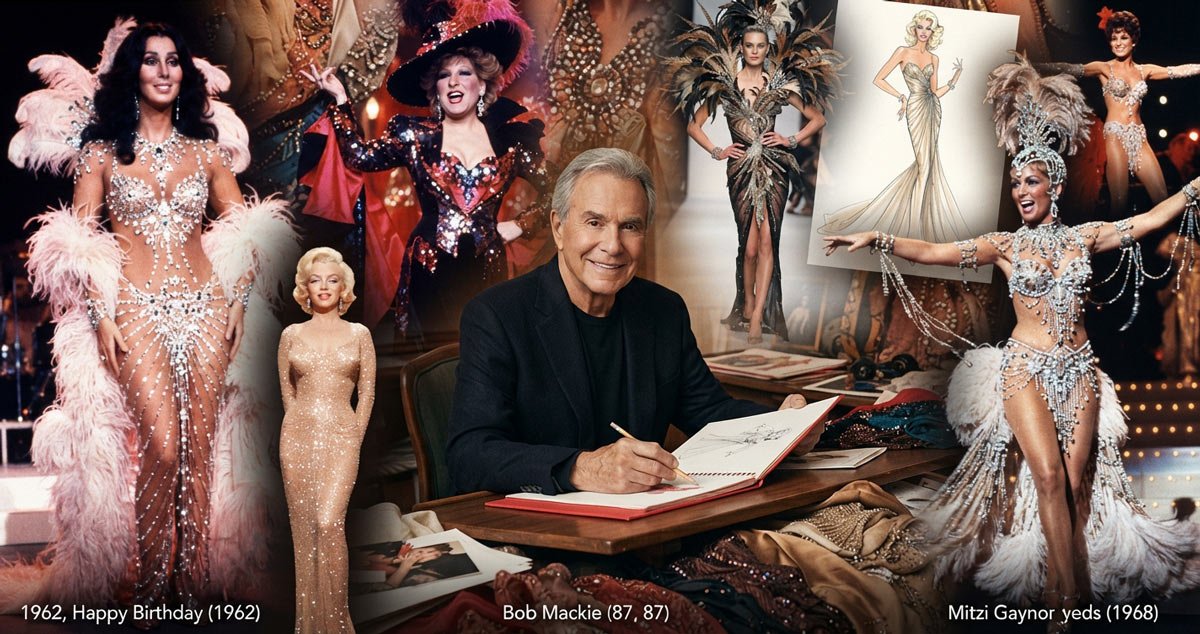
Bob Mackie, the legendary American fashion and costume designer whose dazzling creations helped define Hollywood glamour for generations, has died at the age of 87.
Mackie’s death was announced on September 14, 2026, through his official social media account. The announcement described him as someone who spent his life fulfilling his dream of becoming a fashion and costume designer. His representatives have not publicly disclosed his cause of death or where he died.
For many people, Bob Mackie was more than a fashion designer.
He was the creative force behind some of the most recognizable celebrity images of the last six decades.
He designed unforgettable costumes for Cher, Carol Burnett, Marilyn Monroe, Diana Ross, Tina Turner, Elton John, Dolly Parton, Madonna, Beyoncé, Miley Cyrus and many other performers.
His work transformed clothing into entertainment.
Sequins, feathers, rhinestones, sheer fabrics, elaborate headdresses and dramatic silhouettes became part of the Mackie visual language. But beneath the glitter was something more important: Mackie understood that a costume could become part of a performer's identity.
That is why his influence remains visible long after the original television shows, concerts and red carpets have disappeared.
Who Was Bob Mackie?
Bob Mackie was an American fashion and costume designer born on March 24, 1939, in Monterey Park, California.
Over a career spanning more than six decades, he became one of the most influential costume designers in American entertainment.
His professional career began in the early 1960s, when he worked as a sketch artist and designer in Hollywood. He learned from established figures in the industry, including legendary costume designer Edith Head and French-born designer Jean Louis.
That early experience helped Mackie develop an unusual combination of skills.
He could draw beautiful fashion illustrations, understand the practical requirements of television and film production, and, perhaps most importantly, understand how clothing needed to work on a performer.
That last part became the foundation of his career.
Mackie wasn't simply designing clothes for people to wear.
He was designing images.
And some of those images became permanent parts of popular culture.
Bob Mackie Dies at 87
The news of Bob Mackie's death broke on September 14, 2026.
His official Instagram account announced that Mackie had died at 87, describing his life as one dedicated to the dream of becoming a fashion and costume designer.
Major entertainment and fashion publications quickly reported his death, with tributes emphasizing the enormous influence he had on Hollywood, television, stage performance and celebrity fashion.
At the time of publication, Bob Mackie's cause of death had not been disclosed publicly.
That distinction matters because speculation has already begun circulating whenever news of a famous person's death breaks. There is currently no reliable public information establishing a specific cause of death.
What is known is that Mackie was still being celebrated professionally in 2026.
Earlier this year, he was honored at the Palm Springs Art Museum, where Reflections of Glamour: Bob Mackie presented five original gowns and costumes alongside sketches spanning his career.
His death therefore comes at a moment when his work was already receiving renewed attention.
Bob Mackie and Marilyn Monroe
One of Bob Mackie's earliest major associations with Hollywood history came through Marilyn Monroe.
Mackie worked as a sketch artist for Jean Louis, and one of his early assignments involved creating the original sketch for the famous dress Monroe wore while singing "Happy Birthday" to President John F. Kennedy at Madison Square Garden in 1962.
The dress itself was designed by Jean Louis, based on a design by Mackie and constructed for Monroe.
It became one of the most famous garments in American entertainment history.
The dress was extremely sheer and covered with rhinestones, creating the illusion that Monroe was almost wearing nothing beneath the sparkling fabric.
The moment perfectly demonstrated something Mackie would continue exploring throughout his career:
fashion could create an event.
The dress was not merely clothing.
It helped create the visual drama of the performance.
Decades later, that same design would become relevant again when Kim Kardashian wore Monroe's historic dress to the 2022 Met Gala, bringing renewed public attention to the garment and the designers behind it.
Mackie's connection to Monroe therefore represents an important early chapter in a career built around creating clothes that audiences remembered.
Bob Mackie and Cher: One of Fashion's Greatest Partnerships
If there is one celebrity most closely associated with Bob Mackie, it is undoubtedly Cher.
Their creative relationship became one of the defining collaborations between a performer and designer in modern entertainment.
Mackie helped establish the visual identity that audiences came to associate with Cher: dramatic, glamorous, revealing, theatrical and completely unapologetic.
The partnership began during the era of The Sonny & Cher Comedy Hour and continued for decades.
Cher's willingness to take fashion risks gave Mackie enormous creative freedom.
Mackie once described his philosophy around women wearing his clothes in a way that captured his approach: a woman wearing his designs should not be afraid of being noticed.
That philosophy was perfectly suited to Cher.
The 1970s Cher Look
During the 1970s, Cher became one of the biggest television and music personalities in America.
Mackie's costumes helped distinguish her from virtually every other celebrity on television.
He used:
- Sequins
- Feathers
- Rhinestones
- Sheer fabrics
- Dramatic headdresses
- Bare midriffs
- Elaborate embroidery
- Form-fitting silhouettes
- Exotic patterns
- Extreme proportions
The designs weren't subtle.
They weren't supposed to be.
They were built for television.
And television demanded something that ordinary fashion did not: clothes that could communicate an entire personality from across a room and through a television screen.
Mackie understood that better than almost anyone.
The Iconic Cher Oscar Look
One of the most famous examples of the Mackie-Cher partnership came at the Academy Awards.
Cher wore a dramatic Bob Mackie-designed ensemble to the 1986 Oscars featuring a revealing black outfit and enormous feathered headdress.
The look became one of the most memorable red-carpet appearances in Oscar history.
Mackie and Cher continued their creative partnership long after the 1970s, including major stage productions, concert tours and Cher's later Las Vegas performances.
He also designed costumes for The Cher Show, the Broadway musical about Cher's life, winning the Tony Award for Best Costume Design for a Musical in 2019.
Their collaboration demonstrates why Mackie was different from a conventional fashion designer.
He didn't simply dress Cher.
He helped build the visual mythology surrounding her.
Bob Mackie and Carol Burnett
Cher was perhaps Mackie's most famous celebrity collaborator, but Carol Burnett was just as important to his career.
Mackie designed costumes for The Carol Burnett Show throughout its entire eleven-year run.
The relationship gave him a remarkable creative playground.
Comedy costumes have a different purpose from red-carpet gowns.
They have to communicate character, exaggerate physical comedy and sometimes deliver a joke before the performer even speaks.
Mackie excelled at that.
One of the most famous examples was Carol Burnett's iconic curtain dress from the show's parody of Gone with the Wind.
The costume was intentionally ridiculous.
Burnett's character walks through the scene wearing curtains as a dress, complete with the curtain rod still attached.
It became one of television's most recognizable comedy costumes.
And that was Mackie's genius.
He could make glamourous clothing.
But he could also deliberately make clothing ridiculous when the story required it.
That ability to move between glamour, comedy, fantasy and spectacle made him exceptionally valuable to television.
Why Bob Mackie's Designs Looked So Different
Mackie's work is often described using words like "glitter," "glamour" and "sequins."
Those descriptions are accurate, but they don't fully explain his success.
The real secret was performance.
Mackie understood that entertainment clothing needed to move.
A singer performing under stage lights required clothing that reacted to movement.
A television performer needed colors, textures and silhouettes that worked on camera.
A comedian needed exaggerated proportions.
A dancer needed freedom of movement.
A celebrity appearing on a red carpet needed a design that could instantly become an image.
Mackie designed with all of those requirements in mind.
His costumes were therefore theatrical rather than merely fashionable.
This distinction is important.
Fashion often asks:
Does this look good?
Mackie's work often asked:
What happens when this person walks into the room wearing it?
That difference helped make his designs unforgettable.
Bob Mackie's Career Beyond Cher
Mackie's list of clients extended far beyond Cher.
He designed for some of the biggest entertainment figures of the 20th and 21st centuries, including:
- Diana Ross
- Tina Turner
- Carol Burnett
- Elton John
- Dolly Parton
- Madonna
- Barbra Streisand
- Joan Rivers
- Mitzi Gaynor
- Beyoncé
- Miley Cyrus
- Pink
- Liza Minnelli
He also worked extensively in television, film, Broadway, Las Vegas and live performance.
His work with Diana Ross and the Supremes was particularly important during the late 1960s and 1970s.
Mackie collaborated with Ross on television productions and later continued designing for her stage performances.
He also designed costumes for major Las Vegas productions, including Hallelujah Hollywood and Jubilee!, contributing to the visual language of Las Vegas showgirl entertainment.
Bob Mackie's Awards and Achievements
Mackie's career was not simply commercially successful.
It was heavily recognized by the entertainment industry.
He won nine Primetime Emmy Awards and received numerous additional nominations.
He also received three Academy Award nominations for Best Costume Design.
In 2002, he was inducted into the Television Academy Hall of Fame.
His Broadway work brought another major honor.
For The Cher Show, Mackie won the Tony Award for Best Costume Design of a Musical.
The award demonstrated that his work wasn't limited to television and celebrity wardrobes.
He was equally capable of translating his design philosophy into live theater.
A Career Defined by Recognition
Some of the most important milestones in Bob Mackie's career include:
| Achievement | Recognition |
|---|---|
| Television costume design | 9 Primetime Emmy Awards |
| Film costume design | 3 Academy Award nominations |
| Broadway | Tony Award for The Cher Show |
| Television | Television Academy Hall of Fame |
| Fashion and entertainment | Decades of work with major performers |
| Popular culture | Iconic designs worn by generations of celebrities |
These awards only tell part of the story.
The bigger achievement was cultural.
People who may never have known Mackie's name often knew his designs.
Bob Mackie's Influence on Modern Celebrity Fashion
Mackie's influence didn't disappear as the decades changed.
Quite the opposite.
His work repeatedly returned to popular culture.
A new generation of performers began wearing vintage Mackie designs, proving that the visual language he developed decades earlier still worked.
Miley Cyrus, for example, wore a vintage Mackie design from his 2002 To Broadway with Love collection during the 2024 Grammy Awards.
Contemporary stars including Zendaya and Taylor Swift have also been associated with Mackie's designs or archive pieces.
That resurgence is significant.
Fashion frequently cycles through old trends, but Mackie's work is not simply nostalgic.
His designs remain useful because modern performers still need spectacle.
Today's celebrity culture relies heavily on photographs, red carpets, social media and viral moments.
In that environment, Mackie's fundamental design philosophy makes perfect sense.
Create something people cannot ignore.
Bob Mackie Was More Than "The Designer Who Used Sequins"
It would be easy to reduce Mackie's legacy to glitter and rhinestones.
That would be a mistake.
His real contribution was understanding the relationship between performer, costume and audience.
He understood that an entertainer does not simply wear a costume.
The costume becomes part of the performance.
Consider Cher.
Her Mackie costumes became inseparable from her public identity.
Consider Carol Burnett.
Her costumes could become comedy props.
Consider Tina Turner.
The clothing amplified the physical intensity of her performances.
Consider Diana Ross.
The clothing helped establish the elegance and grandeur surrounding her stage persona.
This is why Mackie's work has survived.
He designed for personalities, not mannequins.
Bob Mackie's Later Career
Although his greatest fame came from television and stage work during the second half of the 20th century, Mackie continued working well into the 21st century.
He developed ready-to-wear collections and had a long-running relationship with QVC.
He also created collectible Barbie dolls and continued collaborating with entertainment figures.
His work remained commercially relevant because the Mackie aesthetic was instantly recognizable.
A Bob Mackie design generally looked like a Bob Mackie design.
That kind of visual identity is rare.
In an industry where trends change quickly, Mackie's signature remained remarkably consistent.
Bob Mackie's Final Years and Continued Recognition
Mackie remained part of the fashion conversation in the years immediately preceding his death.
In 2024, he appeared publicly alongside Cher at the premiere of Bob Mackie: Naked Illusion, a documentary focused on his life and work.
His designs were also being rediscovered by younger audiences through vintage fashion and celebrity styling.
In January 2026, the Palm Springs Art Museum presented Reflections of Glamour: Bob Mackie, featuring five original gowns and costumes along with sketches created across several decades.
That exhibition is especially significant in retrospect.
Mackie's work was not being treated merely as celebrity memorabilia.
It was being presented as art and design history.
Bob Mackie's Legacy After His Death
The question now is not whether Bob Mackie's influence will continue.
It already has.
His designs have become part of the visual history of Hollywood.
The famous Cher costumes.
The Marilyn Monroe connection.
Carol Burnett's comedy wardrobe.
Diana Ross's glamorous stage costumes.
Tina Turner's performance looks.
The theatricality of Las Vegas.
The dramatic world of Broadway.
All of these pieces form one enormous body of work.
Mackie's influence can also be seen in the modern obsession with celebrity fashion moments.
Today, a performer can wear an unusual outfit at an awards ceremony and have the image spread around the world within minutes.
Mackie was working toward that same goal long before social media existed.
He understood that a great costume could become a headline.
A great costume could become an identity.
And occasionally, a great costume could become history.
Why Bob Mackie Mattered to Hollywood
Bob Mackie's importance goes beyond the number of celebrities he dressed or awards he won.
He helped establish a model for what a modern entertainment costume designer could be.
He could work in television.
He could work in theater.
He could work with singers.
He could work with comedians.
He could design for film.
He could create glamorous red-carpet clothing.
He could design intentionally absurd comedy costumes.
And he could make all of those worlds feel unmistakably his.
That versatility is one of the reasons his career lasted for more than six decades.
The End of an Extraordinary Fashion Career
Bob Mackie's death marks the end of an extraordinary chapter in American fashion and entertainment.
He lived to 87 and spent most of his professional life doing exactly what he wanted to do: designing costumes and creating visual fantasy.
His official statement following his death emphasized that fashion and costume design was the dream he pursued throughout his life.
That may be the simplest way to understand his legacy.
Mackie believed entertainment was allowed to be extravagant.
He believed performers were allowed to be glamorous.
He believed clothing could be funny, outrageous, beautiful and completely impractical if the moment demanded it.
And perhaps most importantly, he understood that people watch entertainment because they want to feel something.
Sometimes that feeling comes from a song.
Sometimes from a performance.
And sometimes it comes from a person walking onto a stage wearing something absolutely unforgettable.
Bob Mackie knew how to create that moment.
Frequently Asked Questions About Bob Mackie
Who was Bob Mackie?
Bob Mackie was an American fashion and costume designer best known for his work with celebrities including Cher, Carol Burnett, Marilyn Monroe, Diana Ross and Tina Turner.
How old was Bob Mackie when he died?
Bob Mackie was 87 years old when he died on September 14, 2026.
What did Bob Mackie die from?
As of September 14, 2026, his cause of death has not been publicly disclosed by his representatives or official social media account.
What was Bob Mackie famous for?
Bob Mackie was famous for designing glamorous and theatrical costumes for major entertainment stars. His most famous collaboration was with Cher, but he also created iconic looks for Carol Burnett, Diana Ross, Tina Turner, Marilyn Monroe and many others.
Did Bob Mackie design Cher's clothes?
Yes. Bob Mackie and Cher had one of the most famous designer-performer collaborations in entertainment history. Mackie designed many of Cher's television, concert, red-carpet and stage costumes.
Did Bob Mackie design Marilyn Monroe's famous dress?
Mackie was involved in the creation of the famous Marilyn Monroe "Happy Birthday" dress as a young sketch artist working with designer Jean Louis. He created the original sketch for the design.
How many Emmys did Bob Mackie win?
Bob Mackie won nine Primetime Emmy Awards during his career.
Did Bob Mackie win an Oscar?
No. Mackie received three Academy Award nominations for Best Costume Design, but he did not win an Oscar.
Did Bob Mackie win a Tony Award?
Yes. He won the Tony Award for Best Costume Design of a Musical for The Cher Show.
What was Bob Mackie's most famous design?
There is no single universally accepted "most famous" Bob Mackie design. His work for Cher, Carol Burnett and other performers produced many iconic costumes. His association with Cher's dramatic stage and red-carpet looks is perhaps the strongest part of his public legacy.
Final Thoughts
Bob Mackie didn't simply design costumes.
He designed moments.
For more than 60 years, his work helped define how audiences saw some of the world's biggest entertainers.
He gave Cher an unmistakable visual identity.
He helped turn Carol Burnett's comedy into visual spectacle.
He contributed to one of Marilyn Monroe's most famous appearances.
He dressed Diana Ross, Tina Turner and countless other performers.
And decades after many of his most famous designs first appeared, younger performers continued returning to his archive.
That is perhaps the clearest measure of his legacy.
Trends disappear.
Television shows end.
Concert tours finish.
Red carpets move on.
But an unforgettable image can survive for generations.
Bob Mackie created thousands of them.
His death at 87 closes the life of one of America's most influential costume designers, but the world he created through fabric, feathers, sequins, rhinestones and imagination is unlikely to disappear anytime soon.
Bob Mackie understood something that few designers ever fully master:
Sometimes the clothes don't just complete the performance. They become the performance.
And that is why his name will remain attached to some of the most unforgettable images in entertainment history.